Years ago a client gave me an image for a training site. I assumed they had the rights. The owner came after us for fees. The habit I took from that is simple: check the source before you publish.
The source has changed. The risk used to be a borrowed image. Now it is often a borrowed model. You paste a brief into a writing tool, clone a voice, generate a slide graphic, or drop a chatbot into the LMS. The course ships. Nobody checked the licence, the data flow, or whether learners would know the narrator was not human.
That is the core of the AI legal issues for course creators in 2026. Most problems come from not checking, not from bad intent.
This article is not legal advice. The position differs by country and it is still moving. Use this as a production checklist, then get your own advice for anything material.
I have already covered design-time copyright, privacy, accessibility and some other legal aspects of course creation – check out posts in the Legal and Compliance category if you are interested. This post is what changes when AI sits in the stack.
The article is organised around eight practical issues to check before you publish an AI-assisted course. They cover transparency, ownership, supplier terms, learner data, synthetic voices, accessibility and the quality controls that still need a human decision.
1. EU AI Act transparency and disclosure
If you sell or deliver training to people in the EU, the date that matters is 2 August 2026. That is when Article 50 of the EU AI Act started to apply: transparency duties for systems that talk to people, and for some synthetic image, audio and video.
Article 50 separates provider and deployer duties. Providers of interactive AI systems must design them so people are informed that they are interacting with AI. If you add a third-party AI tutor or chatbot, check that the provider’s required AI-interaction notice is present and clearly displayed. As the course operator, do not hide, remove or contradict it.
Separate deployer duties can apply when you publish deepfakes, use emotion-recognition or biometric-categorisation systems, or publish certain AI-generated text on matters of public interest. If you use a cloned voice or realistic avatar of an identifiable trainer, check whether the deepfake disclosure requirement applies and place the notice where learners encounter the content.
Article 50 applies from 2 August 2026, but do not assume that every older system or item of content is automatically exempt from later transparency or marking requirements. The position depends on the specific obligation, when the system or output was placed on the market or put into use, any applicable transitional provision, and the final guidance. Check the current rules for the system and content you are using. Fines can be significant, although the rules say SME size should be taken into account.
The UK and US do not copy the AI Act. They still regulate areas such as copyright, consumer claims, voice rights and data protection. If you offer AI-enabled learning in the EU or use an AI system whose output is used there, check whether the AI Act applies to your role and activity. Do not assume that being a small business removes the transparency requirements.
Do I have to tell learners I used AI?
Sometimes the law will make you. Sometimes a client, university or awarding body will. Even when nobody has asked, disclosure is a practical way to maintain trust.
Good wording is specific:
- “Lesson narration is an AI voice, used with the trainer’s written consent.”
- “The practice chatbot is an AI system, not a person. A tutor reviews flagged answers.”
- “Some graphics were generated with [tool], then edited.”
You do not need to disclose every brainstorming step. Check that a provider’s required AI-interaction notice is clearly displayed, and label synthetic voices, faces and other content when your role and use trigger a disclosure duty or when disclosure is needed to avoid misleading learners.
2. Copyright ownership of AI-generated course content
Often, not in the way people hope.
In the US, copyright protection requires human authorship, and prompts alone will not normally be enough. The US Copyright Office looks for sufficient human control over the expressive elements. EU copyright also centres on original human intellectual creation, but the detailed position can vary between Member States. In both cases, substantial human selection, arrangement, editing and rewriting strengthen the claim to protection. Do not assume that a raw AI export gives you an enforceable copyright claim.
The UK is different on paper. Section 9(3) of the CDPA provides a 50-year copyright term for some “computer-generated works” with no human author and treats the person who made the necessary arrangements as the author. The UK government’s March 2026 report confirms that the provision remains under review, including whether it should be retained, amended or removed. Until the law changes, section 9(3) remains part of UK copyright law, but its application to current generative-AI workflows is not straightforward.
Practical takeaway: you can sell a course that used AI. What you can protect, and what a client can own, is the human work you put on top — the structure, the examples, the edits, the assessments. Write that into the brief and the contract. The ownership questions in #26/004 Legal considerations for course creators still apply; AI just adds a layer of “what, exactly, did we create?”
3. Tool licences and commercial-use rights
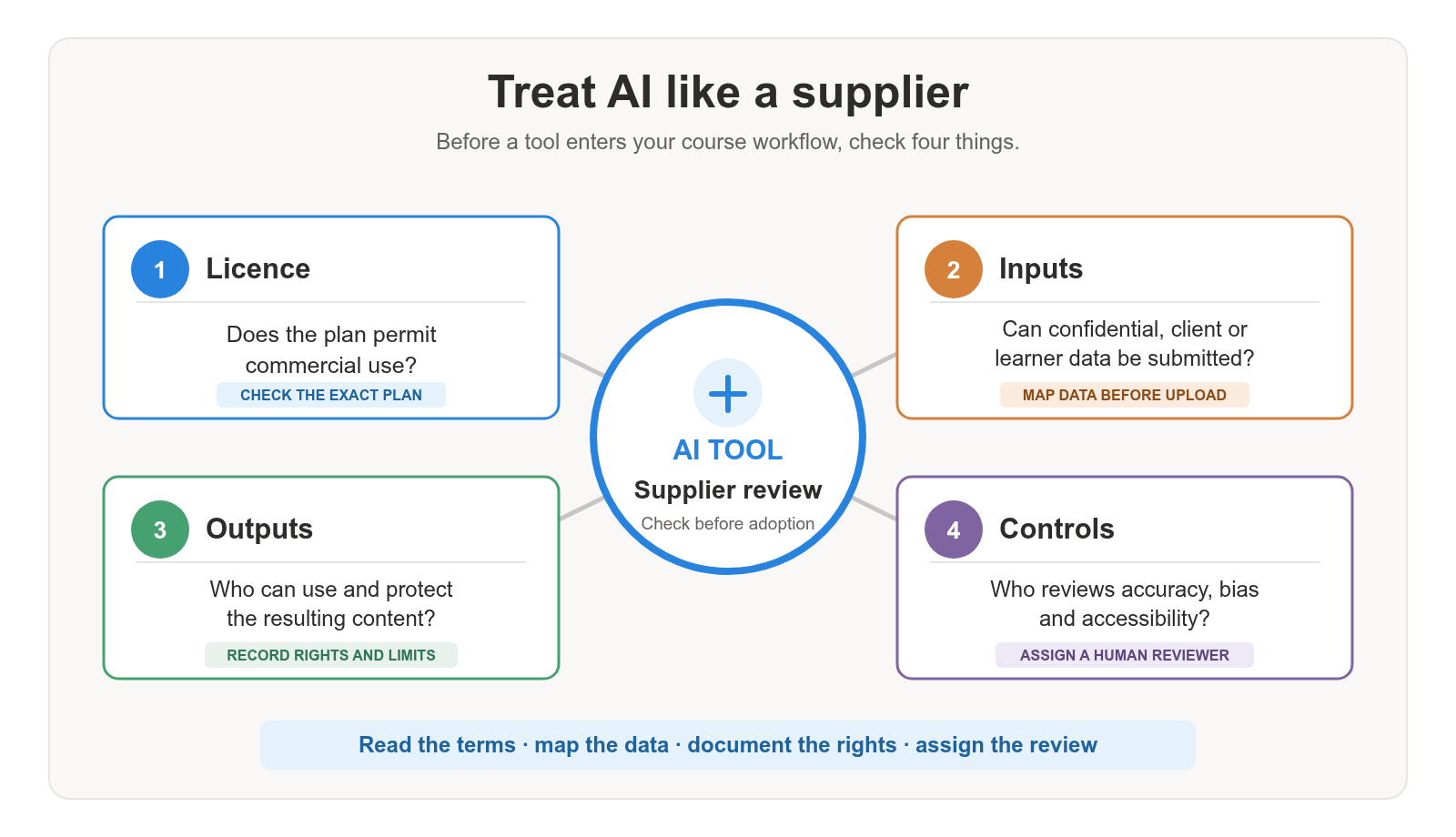
You can usually sell an AI-assisted course if the tool’s terms permit commercial use and you have reviewed the output. The terms are not all the same.
Consumer ChatGPT and similar consumer tools may use your chats to train the model unless you opt out. OpenAI’s business products and API default the other way: they say they do not train on business inputs unless you opt in. If you paste a client script, learner data or an unpublished course into a consumer account, you may have given that text away as training material.
Image-tool rights vary by provider, plan and organisation size. Check the current commercial-use terms for the exact account being used rather than relying on an older summary of free and paid tiers.
Voice and avatar tools add two separate checks: legal permission from the speaker and the platform’s own product rules. Written consent does not override those rules. ElevenLabs currently distinguishes Instant Voice Cloning from Professional Voice Cloning. Its documentation states that a Professional Voice Clone can only be created for the account holder’s own verified voice—even where another person has consented. Check the rules for the cloning method being used and the commercial-use rights attached to the selected plan. Record the speaker’s permission, permitted uses and what happens when they leave the organisation.
Indemnities — OpenAI’s “Copyright Shield” and similar enterprise promises — are not a blank cheque. They tend to sit on paid business plans, come with caps and conditions, and will not save you if you used the tool outside the terms or published unchecked errors. Treat them as a bonus, not as your review process.
4. Learner data and privacy
If an AI tutor, quiz marker or chatbot sees learner answers, names, or documents, that is personal data. GDPR still applies. The EDPB has been clear that putting personal data into a model does not make the GDPR go away.
Ask four questions before you switch the feature on:
- What learner data goes in, and why?
- Does the vendor train on those prompts by default?
- Where is the data stored, and is there a processor agreement?
- Can a learner get a human review if an AI mark or recommendation affects them?
A voice recording is personal data when it relates to an identifiable person. It becomes special-category biometric data when specific technical processing is used for the purpose of uniquely identifying that person. Voice cloning can still create serious privacy, likeness and contractual risks without necessarily being biometric identification. Do not upload a staff member’s voice to a consumer tool “just to try it”.
The tracking and cookie questions from #26/002 – Copyright, Privacy and Accessibility for Course Creators still sit underneath this. AI does not replace a privacy notice. It gives you another processor to name.
5. Voice cloning, consent and likeness
I have written about the tools themselves in AI Voice Cloning Tools for eLearning and about avatars in 14 AI video tools. The legal bit is narrower.
Get written consent that names the use: this course, these languages, this period, paid or internal, and whether the model can be reused after the person leaves. Consent does not override the platform’s cloning rules, so confirm who is permitted to create and control the clone. Store the model somewhere you control. Tell learners when the voice or face is synthetic.
Under the AI Act, a realistic clone of an identifiable person can be a deepfake. Disclosure belongs at first play, not in a footer three clicks away. US state publicity and digital-replica rules are tightening too. If the speaker is in more than one country, do not guess. Put the permission in the contractor or SME agreement.
6. Accessibility and AI-generated alternatives
Auto-captions, machine translation and synthetic narration are useful drafts. They are not a completed accessibility job.
They miss names, miss context, and they cannot tell you whether a learner can finish the course with a keyboard. If you publish them unreviewed, you can still fall short of WCAG 2.2 AA and of the European Accessibility Act duties I sketched in #26/002 – Copyright, Privacy and Accessibility for Course Creators. Use the AI pass, then check the published course the way you would check any other asset.
7. Accuracy, bias and consumer risk
If the course is about first aid, finance, compliance or anything a learner might act on, an AI error is not a small copy edit. It becomes a learner-safety, quality-assurance and potentially consumer-law problem, particularly if the sales page promised a reliable, up-to-date programme.
What can go wrong for you: a takedown, a refund wave, a client saying you breached the brief, a platform removing the course, a reputation hit you cannot unsay in a comment thread.
What can go wrong for the learner: a wrong procedure, a biased example, an undisclosed synthetic coach, or their own writing being used to train someone else’s model.
I still use AI. I do not ship its first draft in a regulated module. A human who knows the subject reads it. That is the whole control.
8. Pre-publishing legal checklist
Add one checkpoint to your production process, next to asset licences and the refund rule. Before you publish or hand over files, run this:
☐ Ownership. You know what is human-authored, what is AI-assisted, and what the client is buying.
☐ Training data in. Inputs are not confidential, personal, or someone else’s unpublished course unless the vendor contract says they stay out of training.
☐ Voice and face. Written consent, scope, exit plan, first-play disclosure.
☐ Learner data. Vendor named in the privacy notice, processor terms in place, human review for anything that scores or advises a person.
☐ Accuracy. Subject-matter review on anything a learner might act on.
☐ Disclosure. The provider’s AI-interaction notice is present and visible. Any deepfake or other synthetic content for which you have a deployer disclosure duty is clearly labelled.
I am building a Legal Checklist for Course Creators as a download. Until that is live, keep this list with the project files.
Your next steps
Pick one course that already uses AI. Check the tool plan, the voice consent, and what learners are told. That is enough for this week.
If you want help building this review into a design workflow, have a look at gerta.eu or tell me in the comments which AI step you keep skipping.
FAQ
Is AI-generated course content protected by copyright?
Not reliably, if a machine produced the expressive part and a human only typed a prompt. The US and EU still look for human authorship. The UK’s computer-generated-works rule is under review. Protect the structure, edits and assessments you actually wrote.
Can I sell a course written with AI?
Yes, if the tool allows commercial use and you have checked the output. Read the current terms. Do not paste client or learner material into a consumer chatbot that trains on chats.
Do I have to tell learners I used AI?
For an ordinary third-party chatbot or AI tutor, check that the provider’s required AI-interaction notice is present and visible; do not hide, remove or contradict it. Separate disclosure duties can apply to you as the deployer when you publish deepfakes, use emotion-recognition or biometric-categorisation systems, or publish certain AI-generated public-interest text. Clients and institutions may require broader disclosure, and clear voluntary labelling can still support learner trust.
Does the EU AI Act apply to a small course business?
It can, if you place an AI system on the EU market or use AI output with people in the EU. Most solo creators are deployers of someone else’s tool, not providers of a general-purpose model. Transparency and data protection are the parts that usually land first. SME size can affect fines, not the duty to be honest with learners.
What if the AI vendor gets sued over training data?
That is mostly their fight. Anthropic’s 2025 authors’ settlement and the UK Getty v Stability judgment show the ground is still unsettled. Your exposure is more practical: an output that looks too close to a known work, a term you ignored, or a course you cannot update if the vendor changes the rules. Keep source files and a human-edited version you control.
References
- Transparency obligations under Article 50 of the AI Act — European Commission
- Safer and more transparent AI — European Commission, 2 August 2026
- Code of Practice on Transparency of AI-generated Content
- Copyright and Artificial Intelligence — U.S. Copyright Office
- Report on Copyright and Artificial Intelligence — UK Government, March 2026
- Using Images and Videos Commercially — Midjourney
- Can I create a Professional Voice Clone of someone else’s voice? — ElevenLabs
- Key data protection concepts for biometric data — ICO
- How your data is used to improve model performance — OpenAI
- EDPB: Artificial intelligence
- Anthropic pays authors $1.5 billion to settle copyright suit — NPR, September 2025
- Getty Images v Stability AI — UK High Court judgment
- AI Voice Cloning Tools for eLearning — Gerta.eu
- 14 AI Video Tools — Gerta.eu