
Rethinking Gagné’s Nine Events for AI-Enhanced Learning
When AI can generate explanations, practice activities and feedback in seconds, instructional designers face a practical question: which parts of lesson design should change, and which should remain grounded in established learning principles?
Gagné’s Nine Events of Instruction provide one way to answer that question. The framework connects instructional activity with processes such as attention, recall, practice, feedback and transfer. In this article, I examine how the events can guide AI-enhanced course design without turning them into a compulsory sequence or treating AI as a substitute for instructional judgement.
What Are Gagné’s Nine Events of Instruction?
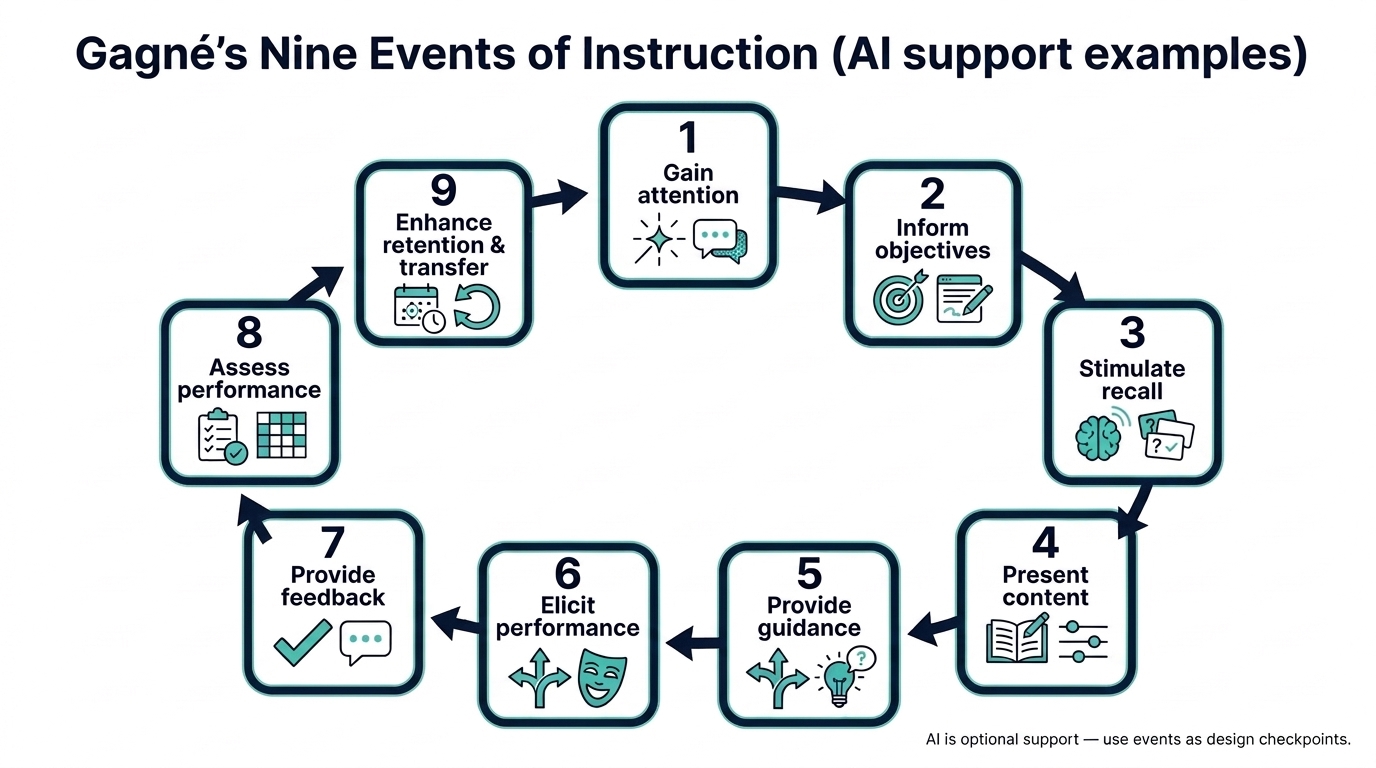
Gagné proposed nine instructional “events” to align external teaching activity with internal learning processes. The widely accepted sequence includes:
- Gaining attention: Capture learners’ focus and establish relevance.
- Informing learners of objectives: Clarify what they are expected to learn or do.
- Stimulating recall of prior learning: Connect new content with existing knowledge.
- Presenting the content or stimulus: Introduce the core material clearly.
- Providing learning guidance: Support understanding with examples, strategies or scaffolding.
- Eliciting performance: Prompt learners to apply what they have learnt.
- Providing feedback: Offer corrective or affirming information about performance.
- Assessing performance: Measure achievement against the learning goals.
- Enhancing retention and transfer: Help learners apply their learning beyond the immediate course context.
The events are intended to support movement from attention and understanding to application and transfer. The Northern Illinois University guide to Gagné’s Nine Events provides a useful introduction to the framework.
Use the Events Flexibly, Not as a Fixed Sequence
The nine events do not need to operate as a strict, single-pass checklist. In practice, they may recur, overlap or appear in a different order according to the learning goal, format and learner needs.
For example, a podcast or short microlearning module might state the goal, present a short piece of content and move directly into a question before offering further guidance. Research examining Gagné’s events in audio podcasts and microlearning illustrates how the framework can be adapted to formats that do not resemble a conventional lesson.
This flexible approach also suits AI-supported learning, where the route through an activity may change in response to a learner’s answers. The events can act as design checks rather than instructions that every learner must follow in the same order.
Generative AI Changes Delivery More Than the Framework
One recent randomised controlled trial examined a generative AI-powered digital tutor in a 16-week nursing course designed around Gagné’s Nine Events. The tutor provided personalised support and adaptive feedback, while the instructional model gave the course a consistent organisational structure. Learners using the AI-supported environment performed better on the reported course measures than learners in the comparison conditions.
This is one example of how an established instructional framework can be combined with AI-supported delivery. It comes from a particular nursing-education setting, so its findings should not be treated as evidence that the same approach will produce equivalent results in every subject, organisation or course format. The full nursing education study provides the details and limitations.
The more useful conclusion for designers is not that AI replaces Gagné’s theory, but that AI can change the speed, format and responsiveness of instruction while the underlying design questions remain. Learners still need relevant goals, appropriate guidance, meaningful practice, dependable feedback and opportunities to transfer learning.
Ground AI Use in Ethical and Pedagogical Decisions
Independent designers and small businesses may have freedom to test a wide range of AI tools. In client, education or organisational settings, however, additional requirements may apply. Follow your organisation’s approval, procurement, data-protection and risk-assessment processes before introducing AI tools into a learning experience.
Other design considerations include:
- Human agency: Learners and educators should retain control over decisions and interpretation. AI-generated recommendations should remain open to questioning and review.
- Assessment integrity: AI-generated outputs can affect the validity and fairness of an assessment. Keep assessment decisions human-led and make permitted AI use explicit.
- Accessibility and inclusion: Test whether the tool works with assistive technologies and whether an equivalent route is available when a learner cannot or does not wish to use it.
- Transparency and privacy: Explain when AI is involved, what information it processes and how learner data will be handled.
- AI literacy: Help learners recognise limitations, possible bias and the need to verify generated material.
- Human oversight: Give educators a way to inspect, correct and override AI-generated content, feedback or recommendations.
These principles align with UNESCO’s guidance for generative AI in education and research, the European Commission’s ethical guidelines on AI and data in teaching and learning, and the US Department of Education report on AI and the future of teaching and learning.
Applying AI Across Gagné’s Nine Events
The table below treats the events as design checkpoints. AI is one possible form of support, not a requirement at every stage.
| Event | Possible AI support | Example or design check |
|---|---|---|
| 1. Gain attention | Generate an opening question, scenario or visual tailored to the subject. | A cybersecurity module could open with a short AI-generated phishing scenario based on the learner’s role. Check that the opening establishes relevance rather than adding novelty for its own sake. |
| 2. Inform learners of objectives | Rephrase approved objectives in plain language or connect them to a learner’s role. | Keep the underlying objective fixed and designer-approved. Do not allow a chatbot to change the expected performance or assessment standard. |
| 3. Stimulate recall | Generate retrieval questions based on prerequisite knowledge and adapt the next prompt to the learner’s response. | In product training, an AI tutor could ask learners to diagnose a familiar customer problem before introducing a new feature. Check that the questions draw on knowledge learners should already possess. |
| 4. Present the content | Offer alternative explanations, examples or formats in response to learner needs. | Review generated content for accuracy, omissions, bias and alignment with the approved source material. Personalisation should not result in different learners receiving contradictory information. |
| 5. Provide learning guidance | Give hints, worked examples or step-by-step coaching without immediately revealing the answer. | In spreadsheet training, an AI coach could identify where a formula went wrong and offer one hint at a time. Decide when the learner should receive a hint and when productive effort should continue. |
| 6. Elicit performance | Run branching scenarios, role-plays or guided practice that responds to learner choices. | A customer-service simulation could play an upset customer and vary its responses according to the learner’s wording. Build the scenario around an approved performance rubric rather than allowing unrestricted improvisation. |
| 7. Provide feedback | Deliver immediate comments linked to criteria and suggest another attempt. | In a course-design activity, AI could compare a learning objective with a rubric and point out missing performance or condition statements. Give learners a way to challenge or request human review of questionable feedback. |
| 8. Assess performance | Support low-stakes scoring, classification or evidence collation. | Use extra caution for high-stakes decisions. Check for bias, document the criteria and retain human responsibility for judgement, exceptions and appeals. |
| 9. Enhance retention and transfer | Schedule retrieval prompts or generate varied practice situations after the initial lesson. | An AI tutor could revisit a procedure after several days and present a new workplace scenario. Confirm that the variation requires genuine transfer rather than repetition with different wording. |
The table can also reveal where AI adds little value. A clear objective, a well-chosen human example or a straightforward checklist may be better than an AI interaction. The decision should follow the learning need, not the availability of a tool.
Common Pitfalls When Combining Gagné’s Model and AI
- Treating AI as a black box: Unchecked generated content or feedback can mislead learners. Define the sources, criteria and review process behind the interaction.
- Following the event order rigidly: A fixed sequence may not suit adaptive lessons, practice loops or learner-controlled exploration. Repeat or reorder events when the learning design calls for it.
- Neglecting accessibility: AI interactions may exclude learners who use assistive technologies or cannot provide the data a tool requires. Test the experience and provide an equivalent alternative.
- Using AI indiscriminately for assessment: Automated scoring can introduce errors, bias or misalignment with the learning outcome. Reserve human judgement for consequential decisions.
- Weakening learner agency: Learners should be able to question AI-generated guidance, understand its limitations and seek human support.
- Adding AI where it does not improve learning: An AI feature can increase cognitive load, cost and risk without improving the activity. A simpler intervention may work better.
Use Gagné’s Events as an Audit Tool
Gagné’s Nine Events can provide a stable set of design questions while AI changes how instruction is delivered. They help designers check whether learners encounter clear goals, relevant prior knowledge, guidance, practice, feedback, assessment and opportunities for transfer. They do not require every course to use the same sequence—or to use AI at every event.
A practical next step is to audit one existing module:
- Mark where each event already appears.
- Identify any gaps that affect the learning goal.
- Note where AI could provide a useful capability, such as adaptive practice or timely feedback.
- Record the associated accuracy, privacy, accessibility and oversight requirements.
- Compare the AI option with a simpler non-AI alternative before deciding.
This turns the framework into a decision aid rather than a formula. If you have tested Gagné’s events in an AI-supported course, share what worked—and where a conventional approach worked better—in the comments.
References
- Gagné’s Nine Events of Instruction
- Effectiveness of a generative AI-powered digital tutor integrated with a knowledge graph-based learning environment in nursing education: a randomized controlled trial
- Guidance for generative AI in education and research
- Microlearning through the Lens of Gagné’s Nine Events of Instruction
- A Sequential Analysis of Gagne’s Nine Events of Instruction in Audio Podcasts
- Ethical guidelines on the use of artificial intelligence and data in teaching and learning for educators
- Artificial Intelligence and the Future of Teaching and Learning