A few years ago I did a last-minute QA on a nutrition course. The client had spent months building it. The graphics looked sharp. A few were still “borrowed for now” from a Google search. The plan had been to replace them. We caught it before launch. She did not have licences.
That is the legal check most people remember: the image you should not have used. The paperwork around selling, hiring and handing work to a client is easier to skip. Legal considerations for course creators are not only about the lesson. You can design a careful course and still get hurt by a vague client contract, a copied programme, a refund wave, or a missing disclaimer.
This article is not legal advice. Rules differ by country and they change. Use this as a practical starting point, then get your own advice for anything material. I have already written about copyright, privacy and accessibility in course design – check out posts in the Legal and Compliance category if you are interested. This post is the business layer around those.
Who owns the course
If you build a course for a client, an institution or a marketplace, do not assume you keep the files. Do not assume the client does either.
In the UK, the person who creates the work is usually the first owner of copyright. If you are an employee, the employer often owns work made in the course of that job. Under the GOV.UK guidance on copyright ownership, a freelancer will usually retain copyright unless there is a contractual agreement to the contrary. When someone commissions a course, the first owner is still the creator, unless you agree a transfer in writing. Without that writing, a client may only get a limited implied licence to use the work for the job they paid for. They may not own the source files, templates or the right to reuse the course in a new programme.
Ireland follows a similar starting point. Section 23 of the Copyright and Related Rights Act 2000 states that the author is generally the first owner of copyright, while an employer is normally the first owner of work created by an employee in the course of employment, unless an agreement says otherwise. Freelancers and clients should still record ownership, licences and source-file rights explicitly rather than relying on that default.
That is the pattern I see on client projects. A company pays for a course. Six months later they want the Storyline file, the slide master and the right to roll it out to another brand. If the statement of work never said who owns what, you are arguing from memory.
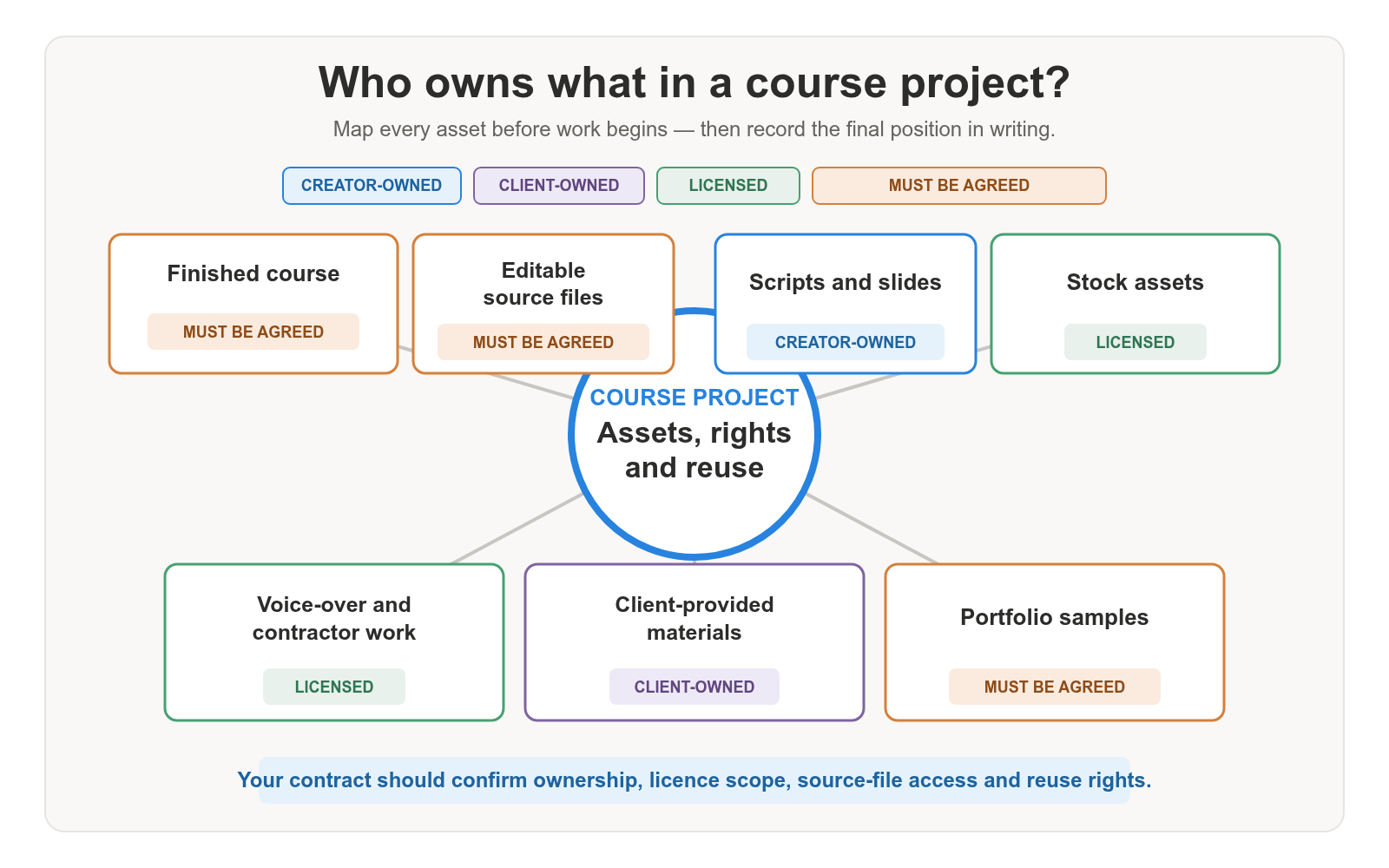
Write down, before you start:
- Who owns the finished course
- Who owns the editable source files
- Whether you can show samples in your portfolio
- Whether the client can reuse the materials internally, publicly, or in a paid product
- What happens to stock, fonts, music, SME video and contractor work inside the course
Marketplace terms are a separate layer. On Udemy you keep ownership of your content and grant the platform a licence. That licence is not the same as a client buy-out. Read the instructor terms before you upload, especially if you also sell the same course on your own site.
Institutional work is messier still. Some universities let educators keep teaching materials. Others claim rights over course structure, recordings or anything hosted on their platform. A 2025 US faculty case about a copied graduate course was dismissed. In that case, the material and allegations presented were not enough to establish the claimed infringement. It is a useful reminder to keep contracts, drafts and dated source files rather than relying only on a general claim that “it was my course”.
Legal considerations for course creators: the contracts you actually need
You do not need a drawer full of templates. You need a few documents that answer specific questions.
Client statement of work. Scope, deliverables, rounds of review, timeline, fee, and the ownership points above. If the client later asks for a second course “based on the same design”, the SOW is what tells you whether that is included.
Contractor agreements. Voice-over, illustration, video edit, translation, SME review. These people often keep copyright in their contribution unless they assign it. If you later sell the course, or the client wants full ownership, you cannot give away rights you never received.
“Work for hire” is not a magic phrase in Ireland or the UK. It is a US copyright idea. Pasting it into a Dublin or London freelance contract does not automatically make the client the author. For most commissioned course work here, you need a written assignment or a clear licence. Say what is being transferred, for which territories, and whether you keep a portfolio right.
Your own terms for learners. If you sell from your site, you need terms that cover access, refunds, what learners may and may not copy, and what you are not promising. A marketplace has its own terms. Those do not replace yours if you also sell direct.
If a contract is silent, you will fill the gap later under pressure. That is when people give away source files, accept a refund they cannot afford, or discover a contractor still owns the narration.
T&Cs, refunds and platform rules
Refunds are where a careful course still loses money.
Under Udemy’s refund policy, learners can usually request a refund within 30 days. Udemy pays instructors after that window, and it can refuse refunds where a notable amount of the course has been consumed, the same person keeps refunding, or there is a pattern of abuse. Read that policy before you treat a sale as income.
If you sell from your own site to consumers in Ireland or elsewhere in the EU, online purchases generally come with a 14-day withdrawal period. However, the detailed position depends on whether your course is treated as digital content, a digital service, a live or tutor-supported service, or a mixture. You must explain the cancellation process before purchase. If you do not provide the required information, the withdrawal period can be extended.
Starting delivery during those 14 days does not automatically remove every cancellation right. Depending on the type of course and the applicable rules, you may need the learner’s express request or consent to begin, an acknowledgement of the consequences, and confirmation in a durable format such as email. A learner may owe a proportionate amount for a service supplied before cancellation, while different conditions can apply to digital content. The Irish CCPC guidance for businesses provides a useful starting point, but your checkout needs to match the course you actually sell. A generic checkbox or a line hidden in the footer is not enough.
The UK position should be checked separately. Under the Consumer Contracts Regulations, the cancellation right for digital content can be lost once supply begins only where the required express consent and acknowledgement have been obtained and confirmed. Services and mixed offers may be treated differently. UK digital content must also match its description and be of satisfactory quality. You cannot write those rights away in your T&Cs. If the sales page promised a live cohort, marked feedback or a downloadable workbook, the course has to deliver that.
Decide your own rule before the first sale:
- What happens if someone asks for a refund after watching most of the course?
- What happens if they bought through a marketplace and through you?
- How long do you wait before you count the income as yours?
Write the answer in your terms. Then follow it, including when a difficult refund request arrives on a Sunday night.
Disclaimers and claims you cannot stand over
A disclaimer does not rescue a promise you should not have made.
If you teach nutrition, fitness, money, careers or “how I replaced my salary”, your sales page is doing legal work. The UK Advertising Standards Authority has investigated a number of advertisers promoting money-making courses over misleading earnings and lifestyle claims.. A small line at the bottom saying “results are not typical” does not fix a headline that treats those results as normal.
Be specific about what the course is. “You will leave with a reviewed lesson plan” is a claim you can stand over. “You will land a six-figure ID role” is not, unless you can show that is what most buyers get.
Use short, plain limits:
- Health, legal or financial topics: this is education, not personal advice
- Career or income: results depend on the learner, the market and work they do after the course
- Credentials: do not imply accreditation you do not have
If you would not put the claim in an email to a solicitor, do not put it on the sales page.
Protecting your own course if someone copies it
Original course materials are usually protected from the moment you create them. That does not mean a platform, a client or a competitor will treat them that way.
In March 2026, a US jury awarded Post University approximately $75.3 million after finding that Learneo’s Course Hero platform infringed the university’s copyright. The case concerned teaching materials that had allegedly been altered to remove copyright notices and made available behind a paywall. Learneo said it would appeal, so the eventual outcome may change. Most independent creators will never see a figure like that. The useful part is smaller: keep your name on the files, keep dated copies, and do not wait until the copy has been live for a year.
Practical steps that do not require a court:
- Put a simple copyright line on slides, workbooks and video end-cards
- Keep a dated folder of source files and published versions
- State in your terms that learners get a licence to use the course, not the right to resell or republish it
- Search for your title, distinctive phrases and slide images a few times a year
- If you find a copy, screenshot the page, note the date and URL, and use the platform’s takedown process first
A solicitor’s letter is the next step when the copy is commercial, the platform will not act, or a client is using work outside the licence you sold. It is not the first email you send to a learner who shared a worksheet with a colleague.
A pre-launch paperwork checklist
Run this before you hit publish or send the final files to a client.
☐ Contractors. Voice, illustration, video, translation and SME contributions are licensed or assigned for the way you will actually use them.
☐ Third-party assets. Every image, font, track and clip has a licence that covers paid courses, the territory and downloadable resources if you offer them. This is the nutrition-course check, done on purpose.
☐ Learner terms. Access rules, what they may copy, and how long they keep access.
☐ Refund rule. Identify whether the offer is digital content, a digital service, a live service or a mixture. Check your own policy, any marketplace policy and the consumer-withdrawal rules for each country where you sell. Make sure the checkout records any required request, consent, acknowledgement and confirmation before access begins.
☐ Claims. Sales page, ads and emails only promise what the course delivers. Disclaimers match the topic.
☐ Your own notice. Copyright line on the materials, and a dated copy stored where you can find it.
I am building a Legal Checklist for Course Creators as a download. Until that is live, use the list above and keep a copy with the project files.
Your next steps
Pick one live course or one client project and run the seven checks. You do not need to fix everything in a week. You do need to know where the gaps are before the next launch.
If you want help building these checks into a design and project workflow, have a look at gerta.eu or tell me in the comments which piece of paperwork you keep putting off.
FAQ
Do I automatically own a course I was paid to build?
Not always. In the UK and Ireland, a freelancer usually owns the copyright unless the contract assigns it. An employee often does not. Payment alone is not a transfer. Get the ownership clause in writing before you start.
What is the difference between a licence and a buy-out?
A licence allows the client to use the course under agreed conditions while you retain copyright. An assignment transfers some or all copyright ownership. Source-file delivery, editing, reuse, resale and portfolio rights should be stated separately because they do not automatically follow ownership. “Buy-out” is useful commercial shorthand, but the contract should identify exactly what is being transferred.
Can I refuse a refund if the learner finished the course?
On a marketplace, start with its refund rules. On your own site, the answer depends on the country, how the course is classified and what happened at checkout. Finishing a course does not by itself settle the question. Check whether the offer is digital content, a digital service, a live service or a mixture, and whether you completed any required consent, acknowledgement and confirmation steps before access began. Separate statutory rights still apply if the course is faulty or does not match what you sold, so a “no refunds” line cannot remove them.
Do I need a disclaimer if I teach a practical skill?
You need honest claims more than a long disclaimer. If the course can affect someone’s health, money or career, say what it is not. Do not use a footer to walk back a headline.
Someone copied my course. What should I do first?
Save evidence, then use the host’s takedown process. Write to the person only if you are sure it is their upload. Speak to a solicitor if the copy is being sold, the platform will not act, or a client is using work outside the contract.
Where do copyright, privacy, accessibility and AI fit?
They still matter. I cover the design-time checks in other posts – check out posts in the Legal and Compliance category if you are interested.
References
- Ownership of copyright works — GOV.UK
- Copyright and Related Rights Act 2000, Section 23: First Ownership of Copyright — Irish Statute Book
- Selling digital content or services — CCPC
- Consumer information and right of withdrawal — EUR-Lex
- Consumer Contracts (Information, Cancellation and Additional Charges) Regulations 2013 — UK legislation
- Consumer Rights Act 2015, digital content to be as described
- Udemy’s refund policy
- Course Hero owner must pay university $75 million — Reuters
- Money-making courses — stick to the facts — ASA
- Faculty IP dispute over online course ownership — Thompson Coburn