When a client asks me to include a video in the programme and ask learners to “review the videos”, I know we need to dig a bit deeper into the real learning problem and consider more interactive video experience, not just share media files or links.
Why “just add the videos” is not enough
A client recently came to me with a programme packed with videos – expert talks, explainers, interviews – all sitting alongside the core content in their LMS. The request sounded straightforward: “Can you add these videos to the core content and additional resources?” There was no clear reason, no defined benefit for learners, and no specific action linked to the request.
As a learning designer and project manager, this is a red flag for me. Instead of simply dumping more content into the course, I reframed the conversation and asked:
- Why are these videos here?
- What should learners do with them?
- How will we know if they actually learned anything?
That shift in focus moved us away from “more content” and towards “better learning”, which is where interactive video experience – in this case H5P – came in.
From passive watching to interactive learning
Once we clarified that the real goal was to reinforce key concepts and check understanding (not just “review” media), we started looking at how to add an interactive layer to the existing videos.
We took key clips from the programme – YouTube videos, as well as the client’s own media files – and rebuilt them as interactive H5P videos. At specific points in each video, we added questions, hotspots and short prompts to nudge learners to pause, think and apply what they had just seen. Research on H5P and interactive video shows that these kinds of embedded interactions can improve learner engagement and performance compared with passive viewing.
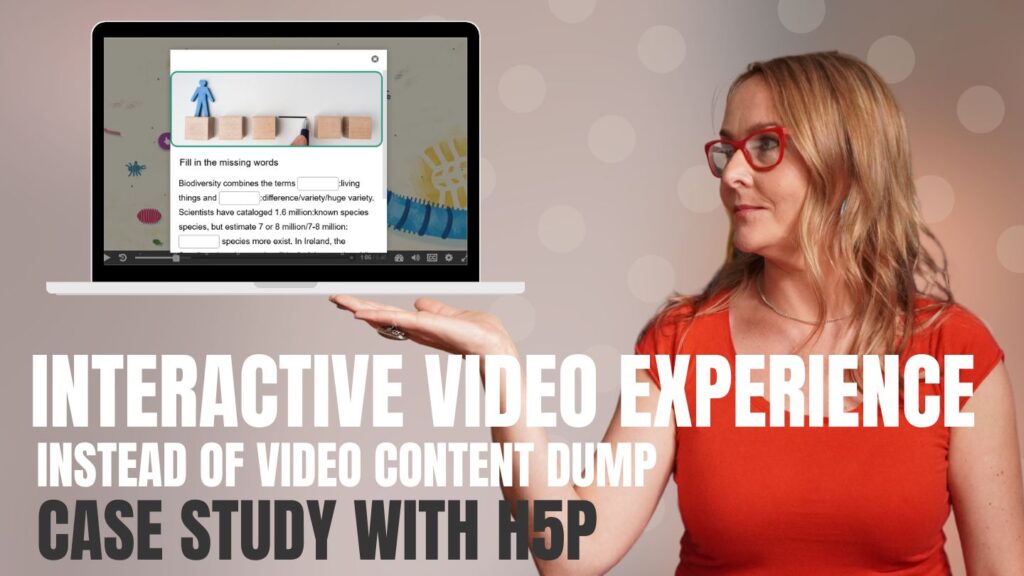
I’m not in a position to share the client’s actual materials, so for this post I mocked up a simple example: a biodiversity video (featuring Sir David Attenborough) transformed into an interactive H5P activity. Instead of learners simply watching a beautiful animation sequence, they are now prompted to:
- Answer questions during the video
- Receive immediate feedback
- Revisit sections based on their answers
This turns “please review this video” into an experience where learners actively process and apply information, which aligns far better with effective learning design principles.
If you are inpatient and want to get to the interactions straight away use the seek bar. They happen when there are little dots above the player bar:

Why H5P worked so well in this project
For this client, using interactive H5P video changed how the programme worked, not just how it looked. Below are the key reasons it made such a difference.
1. Formative feedback built in
We embedded short questions throughout the videos, so learners received instant feedback on their responses instead of waiting until the end of the module. Studies on H5P and interactive video show that this kind of immediate, formative feedback supports understanding and can lead to better quiz performance later on.
This meant the videos stopped being “extra material” and became moments where learners could check their thinking, correct misconceptions and build confidence step by step.
2. Higher engagement with the same content
We didn’t record any new footage; we simply changed how learners interacted with what was already there. By adding clickable hotspots, multiple-choice questions and short reflection prompts, we made the experience more active.
Research and practice in online learning suggest that interactive elements within video increase attention and engagement, compared with watching a long, uninterrupted clip. In this project, learners had to respond, not just watch – which helped keep them mentally present throughout the module.
3. Continuous reinforcement instead of one‑off testing
Instead of one final quiz at the end of a unit, we spaced questions across multiple videos to revisit key ideas in different ways. For example, a concept might first appear as a simple recall question, then later as a short scenario or application question.
Evidence from interactive video experience research shows that this kind of segmentation and distributed questioning supports better knowledge retention than a single test event. For this client, it meant the course could reinforce the core content continually, without feeling like a test-heavy experience.
4. Seamless LMS gradebook integration
One important requirement for this client was to connect learning activities with assessment. The LMS setup allowed us to link H5P interactive video scores with the gradebook and include them as a percentage of the final grade.
H5P integrates well with platforms like Moodle and other LMSs, which means grades and attempt data can feed directly into existing reporting and analytics. This turned “optional videos” into assessed learning activities that still felt low‑stakes and supportive.
5. No extra licensing cost
H5P itself is free to use, which made it an appealing choice from a budget perspective. For organisations that already use an LMS that supports H5P (via plugin or LTI integration), it’s often possible to start experimenting with interactive video without adding another expensive authoring tool.
From a project management point of view, this is helpful: we could improve the learner experience significantly while keeping costs under control and reusing existing assets.
Why clear learner‑focused instructions matter
Underneath all of this, there was another subtle but important shift: we moved from vague, content‑centred instructions (“review the videos”) to clear, learner‑focused tasks.
Instead of telling learners to “watch this video” or “review this resource”, we started writing instructions like:
- “Watch the video and answer the questions as they appear – use the feedback to refine your notes.”
- “Pause after each question and jot down one example from your own context before continuing.”
- “Aim to score at least 80% on the embedded questions; you can rewatch segments as needed.”
Good learning design is not only about selecting the right resources and tools; it is also about giving learners clear directions that explain what to do and why it matters for their progress. Clear instructions reduce cognitive load, guide attention and help learners connect activities to their own goals rather than treating them as random tasks.
In this project, the combination of interactive H5P video and sharper, learner‑centred instructions meant that the same videos suddenly played a very different role in the course: they became structured practice and feedback moments, not just “nice extras”.
What this means for your own courses
If you have a course full of videos and you’re not sure learners are really engaging with them, you don’t necessarily need to start from scratch. Interactive video experience tools like H5P can help you turn “watch this” into “think, apply, and check your understanding” while reusing the content you already have.
Here are a few practical ways you might start:
- Pick one important video and add three or four embedded questions at key points.
- Rewrite the instructions to explain exactly what learners should do during the video and how it will help them.
- If your LMS supports it, connect the H5P score to your gradebook as a small part of the overall assessment, so learners can see that their effort counts.
If you want to explore more ideas, walkthroughs and examples of how I use H5P for interactive video, quizzes and presentations, have a look at my H5P‑related posts on my blog:
Ready to change how your learners experience video?
This short case study is just one example of how a small shift – from passive video to interactive H5P activities with clear instructions – can change the learner experience without a huge production budget. If you’re working on a course and wondering how to make your existing videos more meaningful and measurable.
Book a discovery call – I’d be happy to chat.
Get in touch if you want to explore how you can change your courses in a simple way, and feel free to share your own experiences with interactive video or H5P in the comments on my blog – I’d love to hear what’s working (and what isn’t) in your context.
Select the heading and arrow below to view additional resources on accessibility.
- H5P Interactive Video – eLearning Ninja
- Elearning Assessment H5P Drag & Drop Quiz
- Converting Google Slides into H5P Presentation. Step by Step
- Freebies and Free eLearning Resources
- Learning Design: Understanding Key Principles and Approaches
- Formative and Summative Assessment: Key Differences and Characteristics
- The Basics of Learning Design: Tips for Beginners
- 5 Reasons Why Learner Persona Should Be Used When Creating Online Courses and Training
- Bloom’s Taxonomy: How Can It Help You Design Better Online Courses?
- Five Moments of Need – Your Compass for Workplace Training
- How to Motivate Online Adult Learners – Gilly Salmon’s Model
- Evidence of Improving Knowledge Retention with Interactive Video
- Effectiveness of H5P in Improving Student Learning Outcomes
- Exploring H5P Through the Technology Acceptance Model
- The Cognitive Advantages of Making Interactive Videos with H5P
- Facilitating Student Engagement and Achievement with H5P
- Creating Formative Assessments with H5P
- Interactive Video Tutorial (H5P)
- Adding Interactivity to Your Instructional Videos Using H5P
- Case Study – Applying the HTML5 Package (H5P)
- Technology Integration into Formative Assessment: H5P
- Exploring Interactive H5P Videos: Examples and Activities for Engaging eLearning
- H5P – Official Site
- Set Up H5P for Moodle
Note, that this post provides general information about Interactive Video Experience.
It is important always to consider the specific context and requirements of your learning projects. If you have any questions or would like to delve deeper into the topic, please email me or book a free online consultation via my contact page.
If you want to know more about other about using H5P in your online training or on your website check out my other posts:




Make sure to check out my other posts related to planning online courses, designing and developing learning content and delivering training. I share strategies and tools that you can use and many practical tips.